PAX SILICA AND THE FUTURE OF THE PHILIPPINES: DEVELOPMENT, HUMAN WISDOM, AND THE LIMITS OF NATURE
OPINION | Letter to the Editor Posted on 2026-11-18 13:29:46
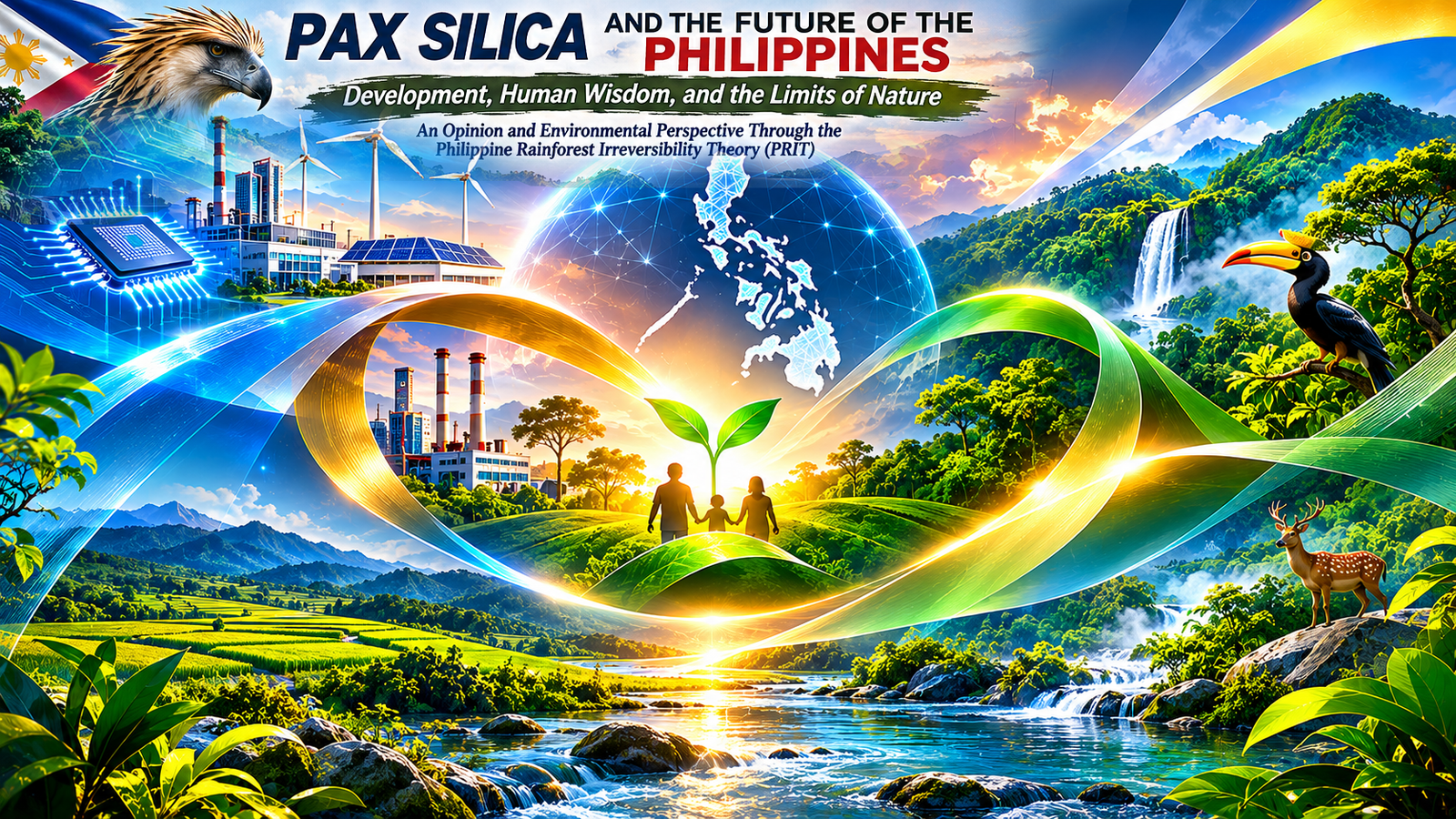
An Opinion and Environmental Perspective Through
the Philippine Rainforest Irreversibility Theory (PRIT)
November
18, 2026 | Philippines
The
growing discussion surrounding the Pax Silica initiative in the Philippines
raises questions that extend far beyond foreign investment, technological
advancement, international cooperation, and economic development. At the heart
of this undertaking lies a fundamental question that every Filipino should
consider: Are we truly prepared to embrace another era of industrial and
technological progress without fully understanding its long-term consequences
for our environment, our communities, and future generations?
I believe
the Philippines must remain open to opportunities that strengthen our economy,
develop our technological capabilities, create employment, and improve our
position in the international community. However, I also believe that every
major development must be examined beyond the promises presented by its
proponents. Economic growth, technological sophistication, and international
partnerships should never become sufficient reasons to disregard the natural
limitations of our environment or the moral responsibilities of humanity.
Pax
Silica, a United States-led international initiative designed to strengthen
strategic supply chains involving critical minerals, semiconductors, artificial
intelligence, energy, and advanced technologies, presents opportunities for
participating nations, including the Philippines. Its objectives reflect the
growing importance of technological independence, industrial resilience, and
international economic security. For a developing country seeking greater
participation in advanced manufacturing and global technology industries, these
opportunities deserve serious consideration.
Nevertheless,
behind the language of economic opportunity are questions concerning
environmental sustainability, land utilization, energy consumption, water
resources, industrial waste, community welfare, national sovereignty, and the
long-term carrying capacity of ecosystems affected by industrial expansion.
These questions must not be dismissed merely because the project is presented
as a strategic investment or an important international partnership.
As a
technology innovator and environmental advocate, I approach this issue through
the perspective of the Philippine Rainforest Irreversibility Theory, or PRIT, a
developing conceptual framework that emphasizes ecological carrying capacity,
environmental resilience, and the possibility that certain disturbances to
natural systems may become difficult or impossible to reverse once critical
thresholds are exceeded.
My
position is straightforward. I am not against Pax Silica. I am against
development that fails to recognize the limitations of nature and the
responsibility of humanity to protect the environment that sustains life.
Understanding the Uncertainty of Human Knowledge
Throughout
human history, civilization has continuously attempted to understand the
mysteries of existence, the origins of life, the behavior of the universe, and
the natural processes governing our planet. From the earliest philosophical
explanations of nature to modern scientific discoveries, humanity has developed
extraordinary knowledge. Yet despite centuries of scientific advancement, there
remain questions that cannot be answered with absolute certainty.
Consider
earthquakes. Modern science has enabled us to identify active faults, monitor
tectonic movements, evaluate geological hazards, and estimate the probability
of seismic events. However, scientists still cannot reliably determine the
exact date, hour, location, and magnitude of a future earthquake. This
limitation does not invalidate geological science. Rather, it demonstrates the
complexity of natural systems and the boundaries of our present predictive
capabilities.
The
continuing development of quantum physics offers another example of how
scientific understanding evolves. Discoveries concerning matter, energy,
probability, and the behavior of particles have transformed our understanding
of physical reality. Scientific knowledge expands as new evidence becomes
available, existing explanations are tested, and more precise theories are
developed.
Even our
understanding of the universe continues to evolve. The Big Bang model provides
a scientifically supported explanation of the universe's early expansion and
development, while evolutionary biology, building upon the contributions of
Charles Darwin and generations of researchers, explains the diversification of
living organisms through natural processes. These scientific frameworks are
supported by substantial evidence, although important questions remain open to
further investigation.
The
history of our planet extends billions of years into the past, long before the
appearance of modern humanity. Geological formations, ancient organisms,
forests, oceans, and ecosystems preserve evidence of that history. Rainforests,
in particular, contain extraordinary biological diversity and complex
ecological relationships that developed over immense periods of evolutionary
time.
For me,
every living organism within a rainforest represents part of a much larger
natural history. From microorganisms beneath the soil to the towering trees
that form the forest canopy, life exists within interconnected systems that
humanity is still working to understand.
We must
recognize that scientific knowledge, although increasingly powerful, does not
grant humanity unlimited control over nature. The inability to predict every
environmental consequence should encourage humility and precaution rather than
excessive confidence in our technological capabilities.
This
understanding is particularly relevant when evaluating large industrial
developments such as those potentially associated with Pax Silica.
Pax Silica: An Economic Opportunity That Requires
Environmental Responsibility
There is
no question that the Philippines needs stronger industries, greater
technological capability, improved infrastructure, and more opportunities for
Filipino workers. Our country cannot remain dependent indefinitely on low-value
economic activities while other nations advance in semiconductor manufacturing,
artificial intelligence, advanced electronics, and industrial research.
Pax
Silica could provide an opportunity to expand our participation in these
industries, attract investments, develop technical expertise, and strengthen
cooperation with international partners. Properly structured partnerships may
also create opportunities for Filipino universities, researchers, engineers,
inventors, and entrepreneurs to participate in the development of emerging
technologies.
However,
the economic benefits of such an initiative are not automatic. They depend on
the actual investment arrangements, technology-transfer commitments, employment
conditions, local participation, environmental requirements, and regulatory
safeguards established during implementation.
It is
also important to distinguish the broader Pax Silica international initiative
from individual industrial, infrastructure, or resource-development projects
that may eventually be undertaken in its name. Each proposed facility,
industrial zone, mineral-processing operation, or infrastructure development
must be assessed according to its actual location, technical specifications,
environmental impacts, and legal obligations.
The
Philippines should not assume that participation in an international
technological partnership necessarily means environmental destruction. Equally,
we should not assume that every project associated with advanced technology is
environmentally sustainable simply because its proponents describe it as
modern, efficient, or strategically important.
Technology
does not automatically guarantee environmental protection. An advanced
industrial facility can still consume enormous quantities of electricity and
water, produce hazardous waste, alter land-use patterns, or affect surrounding
communities if its development is poorly planned and inadequately regulated.
The
responsibility of government and investors is therefore to demonstrate that the
anticipated benefits can be achieved without imposing unacceptable ecological
and social costs.
The Philippine Rainforest Irreversibility Theory
and Ecological Carrying Capacity
The
Philippine Rainforest Irreversibility Theory offers a perspective that I
believe deserves consideration in discussions involving large-scale industrial
development.
At the
center of PRIT is the concept of carrying capacity: the ability of an
environmental system to sustain human activities and ecological processes
without experiencing unacceptable degradation or losing its essential capacity
to function and recover.
A
rainforest, watershed, river basin, agricultural landscape, or coastal
ecosystem cannot absorb unlimited disturbance. Every ecological system has
physical and biological constraints influenced by climate, soil characteristics,
biodiversity, water availability, land use, and the intensity of human
activities.
When
development operates within carefully established environmental limits, certain
impacts may be reduced, managed, or restored. However, when cumulative disturbances
exceed ecological thresholds, the consequences may become increasingly severe,
expensive to correct, or practically irreversible.
This is
the fundamental concern that PRIT seeks to address.
For Pax
Silica-related developments, carrying capacity should not be treated as a
theoretical discussion reserved for academic institutions. It should become a
practical consideration in planning, project approval, engineering design,
implementation, and long-term environmental monitoring.
Before a
major industrial facility is approved, authorities should determine whether the
surrounding watershed can sustainably provide the required water supply. They
should examine whether the electricity demand can be accommodated without
undermining regional energy security or environmental commitments. They should
establish whether the proposed land development threatens forests, agricultural
production, wildlife habitats, groundwater recharge areas, or communities whose
livelihoods depend upon those resources.
The
evaluation must also consider cumulative impacts. A single industrial facility
may appear manageable when examined independently, but several facilities
operating within the same watershed or ecological landscape may collectively
exceed environmental limits.
For this
reason, the environmental carrying capacity of a region should be evaluated
comprehensively rather than through isolated assessments that fail to account
for the combined effects of multiple developments.
The
carrying capacity principle does not mean that every form of industrial
development should be prohibited. It means that development must recognize
measurable limits and remain subject to independent scientific assessment,
continuous monitoring, and corrective intervention.
No
theoretical framework can guarantee perfect environmental outcomes.
Nevertheless, a carrying-capacity approach can help identify risks, establish
safeguards, and determine when proposed activities should be modified,
restricted, relocated, or rejected.
Learning From History Without Becoming Prisoners of
Fear
One of
the concerns surrounding Pax Silica is the possibility that the Philippines may
experience environmental and social problems similar to those associated with
certain industrial or resource-extraction projects in other countries.
History
provides numerous examples of industrial development that generated economic
activity while also producing pollution, environmental degradation,
displacement, and long-term public liabilities. These experiences should not be
ignored.
However,
it would also be unreasonable to assume that every future industrial project
must reproduce the failures of the past.
Historical
experience should serve as evidence for better decision-making, not as an
automatic justification for rejecting every opportunity for development.
We should
investigate the actual circumstances behind environmental failures in other
countries. Were the problems caused by inadequate engineering, weak
enforcement, corruption, improper waste management, insufficient consultation,
excessive extraction, or the failure to recognize ecological limitations?
Understanding
these causes is more productive than relying solely on alarming narratives or
unsupported assumptions.
At the
same time, those who support development must recognize that environmental
concerns are not necessarily products of political opposition or
misinformation. Communities have legitimate reasons to question projects that
may affect their homes, farms, water sources, health, ancestral domains, and
future livelihoods.
The
burden of demonstrating environmental safety and regulatory compliance rests
substantially upon project proponents and the institutions responsible for
approval and oversight.
We must
examine the facts, investigate the risks, and evaluate the safeguards before
arriving at conclusions.
I believe
responsible development requires both openness to opportunity and the
willingness to learn from past mistakes.
When Business Interests Confront Human Morality
Perhaps
one of the most difficult questions surrounding Pax Silica concerns the
relationship between business interests and human morality.
Every
major economic initiative involves organizations and individuals with different
objectives. Investors seek financial returns. Governments pursue economic
growth, employment, and strategic partnerships. Technology companies seek
markets, resources, and opportunities for innovation. Environmental
organizations seek ecological protection, while affected communities seek
security, dignity, and recognition of their rights.
These
interests are not necessarily incompatible, but they can conflict when the
benefits of development are enjoyed by one group while the environmental and
social costs are carried by another.
Public
discussion becomes more complicated when political interests, personal
ambitions, organizational agendas, and public opinion influence the
presentation of information.
Some
individuals may support a project because they genuinely believe it will
improve the country. Others may oppose it because they have identified serious
environmental or social concerns. There may also be participants whose
positions are influenced by political advantage, commercial interests, or the
desire for public recognition.
Nevertheless,
we must be careful not to question the sincerity of every individual merely
because their position differs from our own.
The
legitimacy of an argument should be evaluated through evidence, reasoning,
transparency, and the consequences of the proposed action.
For me,
the moral responsibility of development begins with a simple principle: No
economic benefit should justify knowingly imposing unacceptable and
irreversible harm upon people or the environment.
Profitability
is important for the survival of businesses. Economic growth is important for
national development. But neither can be considered an unlimited entitlement to
exploit natural resources or disregard the welfare of surrounding communities.
A truly
progressive society must be capable of generating prosperity while maintaining
respect for ecological systems and human dignity.
Environmental Laws Must Be Enforced, Not Merely
Announced
The
Philippines already possesses laws, regulatory institutions, and environmental
procedures intended to govern industrial activities and protect natural
resources.
The
Philippine Environmental Impact Statement System, environmental compliance
requirements, water and air quality regulations, protected-area laws, land-use
restrictions, and legislation protecting Indigenous Peoples' rights provide
important safeguards.
However,
the existence of these laws does not automatically guarantee their
effectiveness.
Their
success depends on the quality of environmental assessments, the independence
of technical evaluations, the transparency of government decisions, the
integrity of enforcement institutions, and the willingness to impose penalties
when violations occur.
For
projects associated with Pax Silica, I believe the government should require
credible environmental baseline studies, transparent disclosure of proposed
activities, independent evaluation of cumulative impacts, meaningful community
consultation, and continuous environmental monitoring.
Where
Indigenous Peoples' rights and ancestral domains are affected, applicable legal
protections, including requirements for free, prior and informed consent, must
be respected.
Developers
should also establish clear rehabilitation obligations, emergency response
procedures, pollution-control systems, and financial mechanisms to address
environmental liabilities.
Monitoring
should not end when construction is completed or an environmental permit is
issued. Environmental performance must be evaluated throughout the operational
life of a project and, where necessary, beyond its closure.
The
public must have access to meaningful information about compliance,
environmental conditions, and corrective actions.
If
scientific monitoring demonstrates that an activity is approaching or exceeding
unacceptable ecological limits, authorities must have the capacity and
willingness to require modifications, suspend operations, or enforce
rehabilitation.
This is
where the carrying-capacity principle of PRIT becomes particularly relevant.
Environmental limits must not simply be identified during planning. They must
be respected throughout implementation.
The Future of the Philippines Cannot Be Measured by
Investment Alone
When
government officials announce major international investments, public attention
naturally focuses on projected capital inflows, employment opportunities,
infrastructure development, and expected economic growth.
These
indicators are important, but they do not provide a complete picture of
national progress.
A country
may experience industrial expansion while simultaneously losing agricultural
productivity, degrading watersheds, increasing environmental liabilities, or
weakening the resilience of communities.
If the
financial benefits of a project are concentrated among a limited number of
participants while the ecological costs are transferred to the public, the true
value of that development must be questioned.
For this
reason, I believe the economic evaluation of Pax Silica-related projects should
include long-term environmental costs, resource consumption, public
infrastructure obligations, community impacts, rehabilitation expenses, and the
value of ecosystem services.
The
Philippines must also negotiate meaningful opportunities for domestic
technological participation.
International
partnerships should not merely transform the country into a location for
foreign-controlled industrial facilities. They should help strengthen Filipino
research institutions, engineering capabilities, technology enterprises, and
locally owned industries.
Our
universities, scientists, inventors, entrepreneurs, and young professionals
must be given opportunities to acquire knowledge, develop technologies, and
participate in high-value economic activities.
Technology
transfer should become a meaningful component of industrial cooperation rather
than a promise without measurable commitments.
The
long-term success of Pax Silica should therefore be evaluated not only by the
investments it attracts but also by the technological capabilities Filipinos
develop, the quality of employment created, the protection afforded to affected
communities, and the condition of the environment left behind.
Mother Nature, Irreversibility, and the Limits of
Human Intervention
I have
often reflected on the relationship between humanity and Mother Nature.
Our
planet existed billions of years before modern human civilization. Throughout
its history, Earth has experienced enormous geological, climatic, and
biological transformations. Species have emerged and disappeared, continents
have shifted, ecosystems have developed, and environmental conditions have
changed.
Humanity
has become increasingly capable of altering these natural systems through
agriculture, urbanization, industrialization, resource extraction, and
technological development.
Yet our
capacity to transform the environment has grown much faster than our ability to
fully understand every consequence of those transformations.
We can
construct dams, excavate mountains, redirect rivers, build enormous industrial
complexes, and develop sophisticated systems capable of monitoring
environmental conditions. We can also restore degraded landscapes, improve
water management, reduce pollution, and develop technologies that make resource
use more efficient.
However,
not every environmental disturbance can be completely reversed.
The
extinction of a species cannot simply be undone through ordinary
rehabilitation. The destruction of ancient ecological relationships may require
centuries of recovery, if recovery remains possible at all. Groundwater
contamination, severe soil degradation, and the loss of critical habitats can
create consequences extending far beyond the operating life of an industrial
project.
When I
say that Mother Nature knows what to do when humanity violates the laws of
nature, I express a philosophical understanding of ecological consequences.
Nature does not necessarily act with conscious intention or moral judgment.
Rather, natural systems respond to disturbances according to physical,
chemical, biological, and ecological processes.
If
humanity disregards these processes, the consequences may eventually become
visible through environmental degradation, reduced resilience, resource
scarcity, or the failure of ecosystems to continue providing essential
services.
Science
may offer solutions to many of these problems, but it cannot guarantee that
every loss can be repaired.
This is
why prevention remains more responsible than relying exclusively on future
technological remedies.
A Challenge to Government, Investors, Scientists,
and the Filipino People
The
debate surrounding Pax Silica should become an opportunity for the Philippines
to demonstrate a more responsible approach to industrial development.
Government
leaders must ensure that national economic interests are protected without
compromising environmental laws, community rights, or public accountability.
Investors
and industrial developers must recognize that environmental responsibility is
not merely a regulatory expense. It is a fundamental requirement for the
long-term legitimacy and sustainability of their operations.
Scientists,
engineers, environmental planners, and academic institutions should contribute
independent research and technical evaluation to support evidence-based
decisions.
Civil
society organizations should continue examining potential environmental and
social consequences while ensuring that public discussions remain grounded in verifiable
information.
Communities
must be given meaningful opportunities to participate in decisions affecting
their land, resources, livelihoods, and future.
The
Filipino people deserve a discussion that moves beyond political slogans,
exaggerated promises, and unsupported fears.
We need
transparency rather than secrecy, scientific assessment rather than
speculation, and responsible leadership rather than the pursuit of short-term
advantage.
Most
importantly, we need the wisdom to recognize that development is not an end in
itself.
Its
purpose should be to improve human life without destroying the environmental
foundations upon which that life depends.
My Stand on Pax Silica
I remain
open to the opportunities that Pax Silica may offer the Philippines.
I
recognize its potential contribution to industrial modernization, technological
development, international cooperation, and economic growth.
However,
my support is conditional upon responsible implementation, compliance with
Philippine laws, meaningful protection of affected communities, transparent
project evaluation, and respect for scientifically established environmental
limits.
Through
the perspective of the Philippine Rainforest Irreversibility Theory, I believe
ecological carrying capacity should become a central consideration in
evaluating major industrial investments.
The
Philippines should welcome development that creates genuine opportunities while
maintaining environmental resilience. It should also possess the courage to
reject or modify projects when credible evidence demonstrates that their
consequences exceed acceptable ecological and social limits.
I do not
believe that economic progress and environmental protection must always be
opposing objectives. With appropriate planning, scientific monitoring,
technological innovation, and effective governance, they can become
complementary responsibilities.
But we
must never confuse the possibility of reducing environmental harm with the
assumption that every impact can be eliminated or reversed.
The
future remains uncertain, and no government, scientist, investor, or
environmental advocate can predict every consequence of decisions made today.
What we
can do is examine the evidence, recognize the limitations of our knowledge,
respect the rights of affected communities, and make decisions guided by both
scientific understanding and human wisdom.
Final Reflection: Progress Without Wisdom Is Not
Progress
As
humanity continues to explore artificial intelligence, quantum computing,
advanced manufacturing, and increasingly sophisticated technologies, I
sometimes wonder whether our understanding of human responsibility is advancing
at the same pace as our inventions.
We are
developing machines capable of performing extraordinary calculations and
systems that can analyze information beyond the capacity of any single human
being. We are discovering new scientific principles and expanding the
boundaries of what was once considered impossible.
Yet the
existence of advanced technology does not automatically make humanity wiser.
Human
wisdom must also be reflected in compassion, responsibility, restraint, respect
for life, and recognition of the consequences of our actions.
The
forests, rivers, mountains, oceans, and living organisms surrounding us are not
merely resources waiting to be converted into economic value. They are
essential parts of the natural systems that sustain civilization.
We cannot
claim to understand every mystery of the universe, nor can we predict with
certainty what will happen to our planet centuries from now.
History
teaches us that civilizations rise, technologies evolve, scientific theories
improve, and societies transform. But history also reminds us that the
consequences of human decisions can extend far beyond the generations that made
them.
Pax
Silica may become an important chapter in the industrial and technological
development of the Philippines. Whether that chapter will be remembered as an
achievement in responsible modernization or as another lesson in environmental
mismanagement will depend upon the decisions made by those entrusted with its
planning, approval, and implementation.
I hope
that our leaders, investors, scientists, environmental advocates, and
communities will approach this opportunity with intelligence, humility, transparency,
and genuine concern for the future.
I am not
against development. I am against development without responsibility. I am not
against technology. I am against technological advancement that forgets the
value of life. I am not against Pax Silica. I am against any undertaking that
places economic ambition above the carrying capacity of nature and the welfare
of humanity.
Perhaps
we will never know everything that happened billions of years ago. Perhaps we
will never possess the ability to predict every event that awaits us. But we
possess enough knowledge today to understand that our actions have consequences
and that some environmental losses may become irreversible.
The
challenge before us is not simply to create a more technologically advanced
Philippines. It is to build a country where technological progress,
environmental protection, economic opportunity, and human morality can coexist.
For me,
that is the greater purpose of the Philippine Rainforest Irreversibility
Theory.
Do good.
Think good. Protect nature. Respect humanity. Let progress serve life.
And may
the wisdom of our decisions today become the greatest inheritance we leave to
the generations of tomorrow.
Henry V.
Bayubay
Technology Innovator, Environmental Advocate, and Proponent of the
Philippine Rainforest Irreversibility Theory (PRIT) VP-GM-Filipino Inventors
Society Multipurpose Cooperative (FISMPC)
Author's
Note: This
article expresses the author's independent opinion and proposed application of
PRIT to the Pax Silica initiative. PRIT is presented as a developing environmental
framework, not an independently validated scientific law. The article does not
constitute a site-specific environmental impact assessment or assert that
environmental violations have occurred. Its purpose is to encourage
evidence-based public discussion, environmental responsibility, and sustainable
national development.
Share:
Writer :
Link :
Leave a Comment:
Date: Thursday | November 19, 2026 | 11:14:pm
Sections
Recent News
RECENT POSTS
Philippines Pushes for Lower US Export Tariffs as Marcos-Trump Trade Talks Take Center Stage
Category : Business
Read More →
Philippine Stocks Climb as Oil Prices Ease; Peso Holds Steady Against US Dollar
Category : Business
Read More →
PAX SILICA AND THE FUTURE OF THE PHILIPPINES: DEVELOPMENT, HUMAN WISDOM, AND THE LIMITS OF NATURE
Category : OPINION
Read More →